Community Farm
Construction Company
Food Co-op
Developed policies and practices for establishing an Indigenous Scholarship Program
- Developed scholarship requirements for participation in the Micro Farmer Program and the Community Garden Program.
- Collaborated with Indigenous community leaders to develop inclusive outreach materials and strategize communication with 12 pueblo communities.
- Recruited Indigenous Advisory Council members.
- Served as Advisory Council Coordinator.
- Recruited scholarship candidates.
- Coordinated awardee orientation.
Results: Three-person Indigenous Advisory Council was established to guide Indigenous Scholarship program. Annual awardees gain no-cost access to historically Native American farmlands, water resources, equipment, and education in regenerative farming.
Surveyed farmers, staff, board, volunteers, interns, members, and community partners for feedback on inclusivity and culture.
- Identified harassing behavior from contractor and removed them.
- Implemented board and staff DEI training.
- Improved garden road access and grading.
- Implemented Slack as a farm-wide communication channel.
- Established quarterly micro-farmer meetings with staff.
- Established process to improve community access to board meetings.
- Worked with micro-farmers to developed equitable watering schedule.
- Board created a form for complaints accessed through the website.
Results: Identification of gaps in service, infrastructure, and communications led to solution strategies and implementation.
Approved for $150,000 grant for sustainability upgrades.
- Researched site-specific options for renewable energy, human waste disposal, and surface water management.
- Developed technical and financial proposals for board and adapted with feedback.
- Developed complete proposal for the city parks and recreation department.
- Identified: costs and sources for all equipment.
- Projected reduction in amounts of air pollution, solid waste, CO2, fossil fuels, and water resources.
- Developed community education components.
- Identified underserved populations benefiting from the project.
- Identified emergent employment training and opportunities.
- Worked with the city to format proposal for inclusion in City application for US Dept of Transportation Infrastructure Bill grant funding.
- Developed public communication campaign to solicit feedback on the project in accordance with grant approval requirements.
Results: The organization was approved for the total grant amount of $150,000.
Removed the term “mission” from organizational communications and branding to include Indigenous and non-religious community members.
Results: The organization was able to more effectively fund raise and allocate budget expenses for work that aligned with strategic priorities including EPA grants that required a shared focus on under-served communities and climate change mitigation.
Developed a proposal to steward double the acreage contracted.
The number of applications for the micro-farmer program exceeded the amount of land the organization held in stewardship.
Result: Proposal was approved and organization now stewards 51 acres and irrigation infrastructure.
Developed policies and practices for establishing a Volunteer Program
Recruited a board member and a volunteer coordinator to manage applicants.
Developed a pipeline that included and an interest survey, tracking spreadsheet, follow-up contact, training, and assignment to assist micro-farmers, community gardeners, or the farm coordinator, or to help with events and outreach.
Created a volunteer identification card and reward system of progressively higher-value logo merchandise, education, and event access.
Results: The organization is able to provide volunteer support for all farm participants and staff while delivering education and experience to the community.
Produced public signage with updated branding to address problems occurring in the fields.
Large colorful signs identify the main barn building and the community garden. They share organizational values, contact information, and non-profit status.
Six individual signs forbid dogs from entering the fields and cite the associated health risks and applicable legal statutes with city phone number.
Six signs explain that the harvest from the community garden belongs to leaseholders and is not for public consumption.
Results: The organization is more confident in navigating its relationship with the local community.
Facilitated interactive session with leadership and employees on LGBTQIA+ workplace inclusivity.
Shared A/V presentation on respecting gender non-conforming co-workers including an overview of biological and social context, applicable terminology, pronoun usage, microaggressions, and allyship.
Facilitated company-wide conversation where participants could gain clarification on the presentation, ask open questions, and share concerns. Participants engaged in visioning and problem solving and pledged to support an inclusive workplace.
Result: Gender non-conforming employees reported that they felt supported and believe that the session led to a better workplace culture. Employees and leadership who were not educated about gender non-conforming issues reported that they felt more confident in their ability to support their co-workers.
Edited the Employee Handbook to include definitions of harassment and bullying, identification of prohibited behaviors, and structured consequences for violations.
Results: The organization was clear about the legal differences between harassment and bullying, and were able to move forward with specific consequences for each.
Developed and implemented a variety of required OSHA-compliant construction-specific safety programs.
- Respiratory Protection
- Vision Protection
- Hearing Protection
- Emergency Evacuation Procedures
- Asbestos Safety Protocols
- Facilities Safety
- On-site Accident Procedures
Employees were properly fitted and issued Personal Protective Equipment and trained in its use and maintenance.
Signage was installed to direct evacuation procedures and establish a gathering area.
Client contracts were amended to include the process for identifying asbestos prior to the start of work.
Schedules were created for regularly testing facilities safety equipment and Personal Protective Equipment, and for restocking first aid supplies in kits.
Results: Organization was able to better care for the safety of their workers who reported feeling safer at work; more confident about identifying safety issues; and more certain about what to do in emergency situations.
Guided leadership in the development of foundational documents and operations such as:
- Bylaws
- Statement of Purpose
- Organizational Values
- Operating Agreement
- Employee Handbook
- Employee Safety Handbook
- Contractor Agreements
Results: Founders felt more confident in what the organization represented; and how to make ethical, values-based decisions; how to handle safety and behavioral issues; and how to maintain professional relationships with employees and contractors.
Navigated complex process for allowing beer and wine sales to fund Indigenous Recovery centers in the PNW.
- Developed staff proposal to establish a task force.
- Attended multiple staff meetings for program feedback.
- Interviewed individual staff members in opposition.
- Conducted survey of membership.
- Held a series of public meetings.
- Proposed percentage of alcohol sales to be used for recovery programs, overcoming public opposition.
- Gathered signatures for a member ballot initiative.
- Coordinated public communications campaign.
Surveyed 10 departments to track solid waste production, energy use, water use, and CO2 emissions.
- Establish on-site composting to reduce CO2 emissions.
- Paint existing parking lots and building roof spaces white to reflect excess heat and reduce energy use.
- Assign volunteers to maintain used container recycling station to make area more accessible and reduce plastic waste.
- Source regional cellulose produce bags to replace plastic bags, reducing plastic waste.
- Erect platform for supporting solar panels in parking lots to reduce CO2 emissions.
Results: Reduced Long-lived Green House Gas (LLGHG) emissions by repairing damaged equipment that was identified in the tracking of refrigerant use.
Increased public trust by shared findings, celebrating successes, and identifying challenges.
Additional recommendations:
Removed the term “mission” from organizational communications and branding to include Indigenous and non-religious community members.
- Surveyed staff
- Developed outreach team proposal
- Developed staff proposal
- Attended multiple staff meetings for feedback
- Developed board proposal
- Attended board meetings for feedback
Results: The term “mission” was struck from the language used by the organization. The former “Mission Statement” was replaced with “Statement of Purpose,” creating a more inclusive environment for the community.
Audited the success and challenges of the volunteer program and provided recommendations.
Guided program coordinators in developing an organization-wide internal audit of the volunteer program which included multiple choice and open-ended essay questions.
Administered the survey to 400 anonymous participants who were encouraged to share their experiences and make program recommendations.
Analyzed the responses and developed a body of quantitative and qualitative data using coding.
Worked with program coordinators to develop recommendations for improving the program.
Then worked closely with program coordinators to develop a diversity equity and inclusion training for volunteers.
Results: The recommendation to raise the discount benefit for volunteers was included in a proposal and considered by the finance team. It was then debated by the organization and ultimately passed.
Reverse engineered an organizational brand guide based on materials produced by the original graphic designer.
The organization had spent $10,000 on brand development but had never received a brand guide. Multiple design styles began to circulate, as subsequent staff graphic artists abandoned the core pillars of branded aesthetics and messaging.
In a non-hierarchical organizational structure with co-equal managers, no one person holds the final decision for approval of brand compliance and no one accepts criticism from peers which is seen as bullying. Staff conflicts began to occur around production of non-brand compliant marketing materials.
Result: A source of authority was established with clear parameters and expectations for maintaining brand identity that would transcend individual staff preferences and tenures. Soliciting and integrating feedback from outreach and merchandising teams spread the input across the organization, dissipating hostility toward any individual designers.
Navigated hostile stand-off between department managers which had prevented movement on marketing efforts.
Neither store was visible from main streets. Store #1 was close to a highway but set back on a hill and Store #2 was located in a residential neighborhood.
A highway sign could inform travelers of Store #1’s location, but it could not qualify because it lacked adequate seating for the deli.
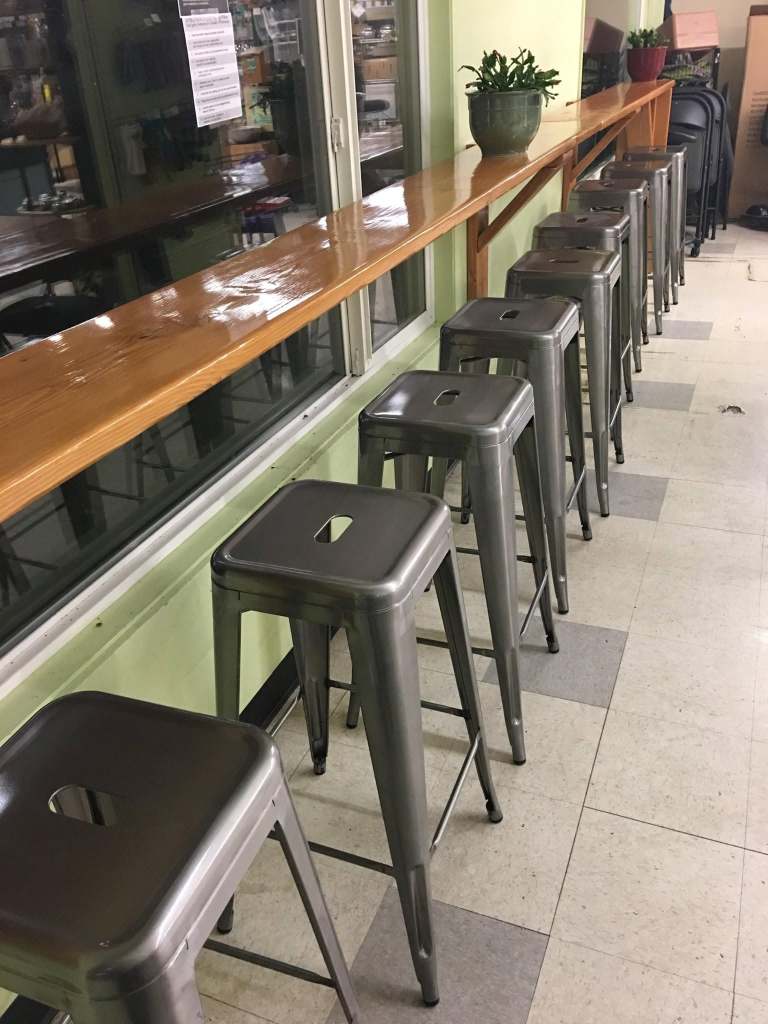
Developed a new eating area layout with a wraparound lunch counter with stools to replace the small tables and chairs. Worked with the merchandising team to relocate several displays and found the lowest bid to build a wooden counter top which could be removed when the space needed to be opened up.
Applied for the highway sign and was approved. Also applied for no-cost informational street signs and due to the organization being registered as a not-for-profit, was approved.
Result: The highway sign is visible to 11,000 vehicles per day on US Highway 101 and at both off-ramps. Directional signs are visible on main roads for both stores.
The organization was strongly purpose-driven and needed to communicate this to the public beyond its membership.
Produced a feature documentary about the organization’s history and impact on the local community and the world.
Produced a year-long video series celebrating the organization’s impact on and cooperation with local organic farmers and producers.
In coordination with the graphic designer produced:
- Bi-weekly flier which featured one local vendor and offered coupons for local products from every department.
- Cards identifying local products with information and photos of the company owners.
- Very large format signs depicting co-op department managers with local company owners and sharing organizational values that they share with the partners.
Result: The organization’s commitment to supporting local producers became clearly evident to shoppers at large and to the local partners who reported feeling more supported after the campaign.
visible to 11,000 vehicles per day on US Highway 101 and at both off-ramps.

